OLine
OLine
 M_OLine
ULine
M_OLine
ULine
 TLine
TLine
 TLine1
TLine2
TLine3
TLine1
TLine2
TLine3
Lossy and lossless segmented transmission lines, and LC distributed line models
This package contains lossy and lossless segmented transmission lines, and LC distributed line models. The line models do not yet possess a conditional heating port.
Extends from Modelica.Icons.Package (Icon for standard packages).
| Name | Description |
|---|---|
| OLine
|
Lossy Transmission Line |
| M_OLine
|
Multiple OLine |
| ULine
|
Lossy RC Line |
| TLine
|
Lossless transmission line with characteristic impedance Z0 and transmission delay TD |
| TLine1
|
Lossless transmission line with characteristic impedance Z0 and transmission delay TD |
| TLine2
|
Lossless transmission line with characteristic impedance Z0, frequency F and normalized length NL |
| TLine3
|
Lossless transmission line with characteristic impedance Z0 and frequency F |
 Modelica.Electrical.Analog.Lines.OLine
Lossy Transmission Line
Like in the picture below, the lossy transmission line OLine is a single-conductor lossy transmission line which consists of segments of lumped resistors and inductors in series and conductor and capacitors that are connected with the reference pin p3. The precision of the model depends on the number N of lumped segments.
To get a symmetric line model, the first resistor and inductor are cut into two parts (R1 and R_Nplus1, L1 and L_Nplus1). These two new resistors and inductors have the half of the resistance respectively inductance the original resistor respectively inductor.
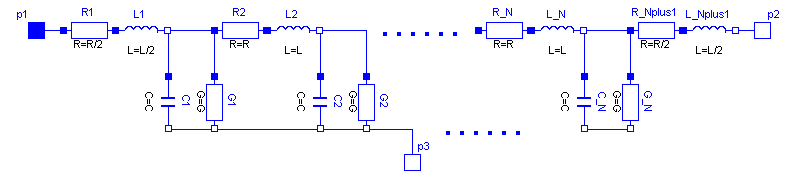
The capacitances are calculated with: C=c*length/N.
The conductances are calculated with: G=g*length/N.
The resistances are calculated with : R=r*length/(N+1).
The inductances are calculated with : L=l*length/(N+1).
For all capacitors, conductors, resistors and inductors the values of each segment are the same except of the first and last resistor and inductor, that only have the half of the above calculated value of the rest.
The user has the possibility to enable a conditional heatport. If so, the OLine can be connected to a thermal network. When the parameter alpha is set to a value greater than zero, the OLine becomes temperature sensitive due to their resistors which resistances are calculated by R_actual = R*(1 + alpha*(heatPort.T - T_ref)) and conductors calculated by (G_actual = G/(1 + alpha*(heatPort.T - T_ref)).
Note, this is different to the lumped line model of SPICE.
References: [Johnson1991]
| Name | Description |
|---|---|
| r | Resistance per meter [Ohm/m] |
| l | Inductance per meter [H/m] |
| g | Conductance per meter [S/m] |
| c | Capacitance per meter [F/m] |
| length | Length of line [m] |
| N | Number of lumped segments |
| alpha_R | Temperature coefficient of resistance (R_actual = R*(1 + alpha*(heatPort.T - T_ref)) [1/K] |
| alpha_G | Temperature coefficient of conductance (G_actual = G/(1 + alpha*(heatPort.T - T_ref)) [1/K] |
| useHeatPort | = true, if heatPort is enabled |
| T | Fixed device temperature if useHeatPort = false [K] |
| T_ref | Reference temperature [K] |
| Name | Description |
|---|---|
| p1 | |
| p2 | |
| p3 | |
| heatPort |
 Modelica.Electrical.Analog.Lines.M_OLine
Multiple OLine
The M_OLine is a multi line model which consists of several segments
and several single lines. Each segment consists of resistors and inductors that
are connected in series in each single line, and of capacitors and conductors both
between the lines and to the ground. The inductors are coupled to each other like in the
M_Transformer model.
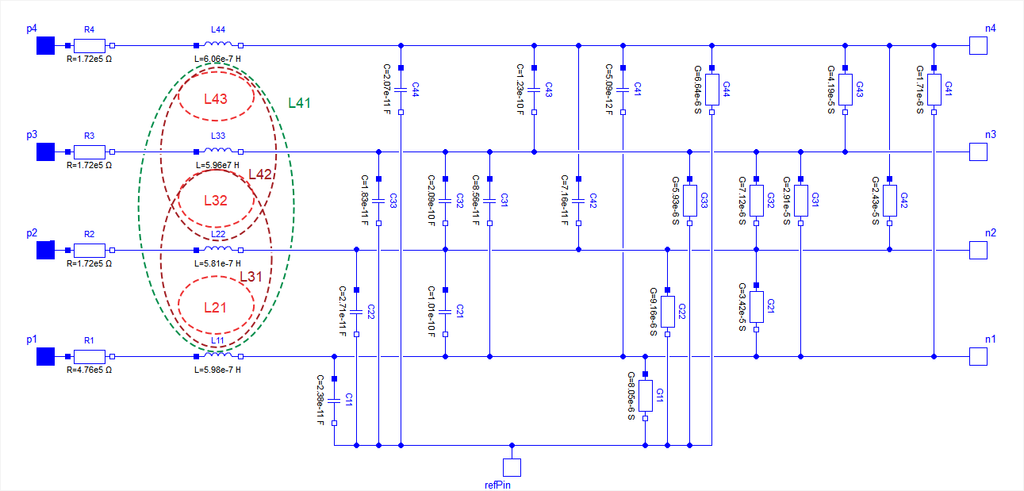
The following picture shows the schematic of a segment with four single lines (lines=4):
Note that the user can choose whether the optional "refPin" is active (so that it can be connected to any other pin), otherwise the internal "ground" is used. This is done with the checkbox useInternalGround, true by default (for compatibility with previous versions). Obviously the potential of the internal ground is always zero, its current can be accessed for plotting.
The complete multi line consists of N segments and an auxiliary segment_last:
-- segment_1 -- segment_2 -- ... -- segment_N -- segment_last --
In the picture of the segment can be seen, that a single segment is asymmetrical.
Connecting such asymmetrical segments in a series forces also an asymmetrical multi line.
To design a symmetrical model which is useful for coupling and which guaranties the same pin properties,
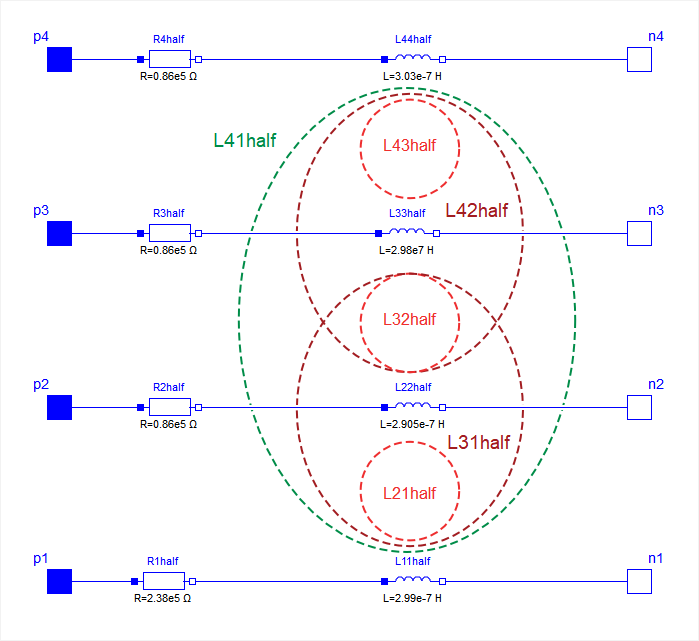
in segment_1 only half valued resistors and inductors are used.
The remaining resistors and inductors are at the other end of the line within
the auxiliary segment_last. For the example with 4 lines the schematic of
segment_last is like this:
The number of the capacitors and conductors depends on the number of single lines that are used,
because each line is coupled to every other line by both a capacitor and a conductor.
One line consists of at least two segments.
Inside the model M_OLine the model segment is used.
This model represents one segment which is build as described above.
For modelling the inductances and their mutual couplings the model
M_Transformer is used.
To fill the resistance vector, resistance values as many as lines are needed, e.g.,
if there are four lines, four resistances are needed. For example for a microelectronic line
of 0.1m length, a sensible resistance-vector would be R=[4.76e5, 1.72e5, 1.72e5, 1.72e5].
Filling the matrices of the inductances, capacitances and conductances is a bit more complicated,
because those components occur also between two lines and not only (like the resistor) in one line.
The entries of the matrices are given by the user in form of a vector.
The vector length dim_vector_lgc is calculated by:
dim_vector_lgc = lines*(lines+1)/2
Inside the model a symmetrical inductance matrix, a symmetrical capacitance matrix and a symmetrical conductance matrix are built out of the entries of the vectors given by the user. The way of building is the same for each matrix, so the approach for filling one of the matrices will be shown in the the example below.
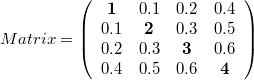
The number of lines is assumed to be four. To build the matrix, the model needs the values from the main diagonal and from the positions that are below the main diagonal. To get the following matrix
the vector with dim_vector_lgc=4*5/2=10 has to appear in the following way: vector = [1, 0.1, 0.2, 0.4, 2, 0.3 0.5, 3, 0.6, 4]
For the example of a microelectronic line of 0.1m length,
which is used as default example for the M_OLine model,
a sensible inductance-matrix would be:
For the example of a microelectronic line of 0.1m length, which is used as default example
for the M_OLine model, a sensible capacitance-matrix would be:
For the example of a microelectronic line of 0.1m length, which is used as default example
for the M_OLine model, a sensible conductance-matrix would be:
The user has the possibility to enable a conditional heatport. If so, the M_OLine
can be connected to a thermal network. If the parameter alpha is set to a value different than zero,
the M_OLine becomes temperature sensitive due to their resistors which resistances
are calculated by
R_actual = R*(1 + alpha*(heatPort.T - T_ref))
and conductors calculated by
G_actual = G/(1 + alpha*(heatPort.T - T_ref))
| Name | Description |
|---|---|
| length | Length of line [m] |
| N | Number of lumped segments |
| lines | Number of lines |
| r[lines] | Resistance per meter [Ohm/m] |
| l[dim_vector_lgc] | Inductance per meter [H/m] |
| g[dim_vector_lgc] | Conductance per meter [S/m] |
| c[dim_vector_lgc] | Capacitance per meter [F/m] |
| useInternalGround | = true if internal ground is used, otherwise use reference pin |
| alpha_R | Temperature coefficient of resistance (R_actual = R*(1 + alpha*(heatPort.T - T_ref)) [1/K] |
| alpha_G | Temperature coefficient of conductance (G_actual = G/(1 + alpha*(heatPort.T - T_ref)) [1/K] |
| useHeatPort | = true, if heatPort is enabled |
| T | Fixed device temperature if useHeatPort = false [K] |
| T_ref | Reference temperature [K] |
| Name | Description |
|---|---|
| heatPort | |
| p[lines] | Positive pin |
| n[lines] | Negative pin |
| refPin | Reference pin |
Modelica.Electrical.Analog.Lines.ULineLossy RC Line
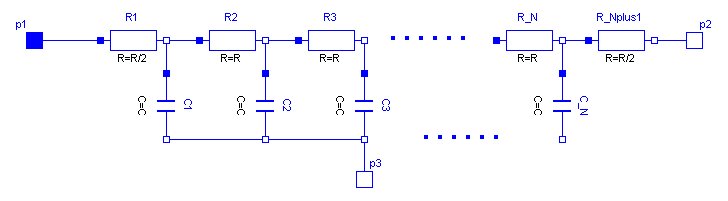
As can be seen in the picture below, the lossy RC line ULine is a single conductor lossy transmission line which consists of segments of lumped series resistors and capacitors that are connected with the reference pin p3. The precision of the model depends on the number N of lumped segments.
To get a symmetrical line model, the first resistor is cut into two parts (R1 and R_Nplus1). These two new resistors have the half of the resistance of the original resistor.
The capacitances are calculated with: C=c*length/N.
The resistances are calculated with: R=r*length/(N+1).
For all capacitors and resistors the values of each segment are the same except for the first and last resistor, that only has the half of the above calculated value.
The user has the possibility to enable a conditional heatport. If so, the ULine can be connected to a thermal network. When the parameter alpha is set to a value greater than zero, the ULine becomes temperature sensitive due to their resistors which resistances are calculated by R_actual= R*(1 + alpha*(heatPort.T - T_ref)).
Note, this is different compared with the lumped line model of SPICE.
References: [Johnson1991]
| Name | Description |
|---|---|
| r | Resistance per meter [Ohm/m] |
| c | Capacitance per meter [F/m] |
| length | Length of line [m] |
| N | Number of lumped segments |
| alpha | Temperature coefficient of resistance (R_actual = R*(1 + alpha*(heatPort.T - T_ref)) [1/K] |
| useHeatPort | = true, if heatPort is enabled |
| T | Fixed device temperature if useHeatPort = false [K] |
| T_ref | Reference temperature [K] |
| Name | Description |
|---|---|
| p1 | |
| p2 | |
| p3 | |
| heatPort |
 Modelica.Electrical.Analog.Lines.TLine
Lossless transmission line with characteristic impedance Z0 and transmission delay TD
Lossless transmission line with characteristic impedance Z0 and transmission delay TD. The lossless transmission line TLine is a two Port. Both port branches consist of a resistor with characteristic impedance Z0 and a controlled voltage source that takes into consideration the transmission delay TD. For further details see [Branin1967]. The model parameters can be derived from inductance and capacitance per length (L' resp. C'), i. e. Z0 = sqrt(L' / C').
There are three possibilities for specifying the transmission delay TD:
Resistance R' and conductance G' per meter are assumed to be zero.
References: [Branin1967], [Hoefer1985]
Extends from Modelica.Electrical.Analog.Interfaces.TwoPort (Component with two electrical ports, including current).
| Name | Description |
|---|---|
| Z0 | Characteristic impedance [Ohm] |
| TD | Transmission delay: specify > 0 if F and NL are not given [s] |
| F | Frequency: specify > 0 if TD is not given [Hz] |
| NL | Normalized length: specify if TD is not given |
| Name | Description |
|---|---|
| p1 | Positive electrical pin of port 1 |
| n1 | Negative electrical pin of port 1 |
| p2 | Positive electrical pin of port 2 |
| n2 | Negative electrical pin of port 2 |
 Modelica.Electrical.Analog.Lines.TLine1
Lossless transmission line with characteristic impedance Z0 and transmission delay TD
Lossless transmission line with characteristic impedance Z0 and transmission delay TD The lossless transmission line TLine1 is a two Port. Both port branches consist of a resistor with characteristic impedance Z0 and a controlled voltage source that takes into consideration the transmission delay TD. For further details see [Branin1967]. The model parameters can be derived from inductance and capacitance per length (L' resp. C'), i. e. Z0 = sqrt(L'/C') and TD = sqrt(L'*C')*length_of_line. Resistance R' and conductance C' per meter are assumed to be zero.
References: [Branin1967], [Hoefer1985]
This model is replaced by TLine with appropriate parameterization.
Extends from Modelica.Electrical.Analog.Interfaces.TwoPort (Component with two electrical ports, including current), Modelica.Icons.ObsoleteModel (Icon for classes that are obsolete and will be removed in later versions).
| Name | Description |
|---|---|
| Z0 | Characteristic impedance [Ohm] |
| TD | Transmission delay [s] |
| Name | Description |
|---|---|
| p1 | Positive electrical pin of port 1 |
| n1 | Negative electrical pin of port 1 |
| p2 | Positive electrical pin of port 2 |
| n2 | Negative electrical pin of port 2 |
Modelica.Electrical.Analog.Lines.TLine2Lossless transmission line with characteristic impedance Z0, frequency F and normalized length NL
Lossless transmission line with characteristic impedance Z0, frequency F and normalized length NL The lossless transmission line TLine2 is a two Port. Both port branches consist of a resistor with the value of the characteristic impedance Z0 and a controlled voltage source that takes into consideration the transmission delay. For further details see [Branin1967]. Resistance R' and conductance C' per meter are assumed to be zero. The characteristic impedance Z0 can be derived from inductance and capacitance per length (L' resp. C'), i. e. Z0 = sqrt(L'/C'). The normalized length NL is equal to the length of the line divided by the wavelength corresponding to the frequency F, i. e. the transmission delay TD is the quotient of NL and F.
References: [Branin1967], [Hoefer1985]
This model is replaced by TLine with appropriate parameterization.
Extends from Modelica.Electrical.Analog.Interfaces.TwoPort (Component with two electrical ports, including current), Modelica.Icons.ObsoleteModel (Icon for classes that are obsolete and will be removed in later versions).
| Name | Description |
|---|---|
| Z0 | Characteristic impedance [Ohm] |
| F | Frequency [Hz] |
| NL | Normalized length |
| Name | Description |
|---|---|
| p1 | Positive electrical pin of port 1 |
| n1 | Negative electrical pin of port 1 |
| p2 | Positive electrical pin of port 2 |
| n2 | Negative electrical pin of port 2 |
Modelica.Electrical.Analog.Lines.TLine3Lossless transmission line with characteristic impedance Z0 and frequency F
Lossless transmission line with characteristic impedance Z0 and frequency F The lossless transmission line TLine3 is a two Port. Both port branches consist of a resistor with value of the characteristic impedance Z0 and a controlled voltage source that takes into consideration the transmission delay. For further details see [Branin1967]. Resistance R' and conductance C' per meter are assumed to be zero. The characteristic impedance Z0 can be derived from inductance and capacitance per length (L' resp. C'), i. e. Z0 = sqrt(L'/C'). The length of the line is equal to a quarter of the wavelength corresponding to the frequency F, i. e. the transmission delay is the quotient of 4 and F. In this case, the characteristic impedance is called natural impedance.
References: [Branin1967], [Hoefer1985]
This model is replaced by TLine with appropriate parameterization.
Extends from Modelica.Electrical.Analog.Interfaces.TwoPort (Component with two electrical ports, including current), Modelica.Icons.ObsoleteModel (Icon for classes that are obsolete and will be removed in later versions).
| Name | Description |
|---|---|
| Z0 | Natural impedance [Ohm] |
| F | Frequency [Hz] |
| Name | Description |
|---|---|
| p1 | Positive electrical pin of port 1 |
| n1 | Negative electrical pin of port 1 |
| p2 | Positive electrical pin of port 2 |
| n2 | Negative electrical pin of port 2 |